CSW 69
From March 10 to 21, 2025, the UN Commission on the Status of Women held the 69th session with the priority theme of the review, appraisal and the implementation of the Beijing Declaration and Platform for Action and the outcomes of the 23rd special session of the General Assembly.
With over 13,000 people attending the session, it was the largest ever gathering of the CSW. There were 5845 representatives from NGO’s attending over 1,000 in-person and virtual meetings during the two-week period.
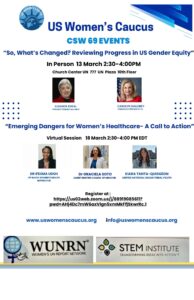
The US Women’s Caucus held two events, one in-person event on March 13 at the UN Church Center entitled, “So, What’s Changed? Reviewing Progress in US Gender Policy,” with guest speakers Fromer US Representative Carolyn Maloney and Eleanor Smeal, President of the Feminist Majority.
The Caucus also sponsored a virtual seminar on March 18 “Emerging Dangers for Women’s Healthcare – A Call to Action” hosted by Dr. Graciela Soto, from the Albert Einstein College of Medicine. Speakers included Dr. Ifeoma Udoh, VP of the Black Women’s Health Initiative; Kiara Tanta –Quidgeon, from United National Indian Tribal Youth and Pauline Briggs,
Executive Director of the WeHealth Clinic in Duluth Minnesota.
Special Projects Commemorating Beijing +30
To celebrate the 30 th anniversary of the 4 th UN Conference on Women in Beijing, and the adoption of the Beijing Platform for action on Women’s Rights, the US Women’s Caucus worked on several special projects.
I. US Shadow Reports on the Beijing Platform
The Caucus compiled short briefs on each of the 12 main areas of concern from the Beijing Platform for Action outlining what progress has and has not been made on those topics in the US since 1995.
Beijing+30 Shadow Report Summary: What Has Changed for US Women Since Beijing?
Women in Power and Decision Making
Education and Training of Women
II. Beijing +30 Survey
How Much Progress Has the US Made on Women’s Rights since 1995?
In 2024, The USWC decided to do a survey of American women to determine what progress had been made in the United States since the Beijing Platform for Action was adopted 30 years before. We wanted to learn not only which of the 12 main areas of concern had progress been made, but also what issues were of most concern today in their own communities.
We conducted a wide survey covering women and girls of various ages, including those who attended the Beijing conference in 1995, as well as women from rural areas, minorities, and other groups such as single heads of household. USWC Board Member Dr. Graciela Soto, who is Clinical Associate Professor at Albert Einstein College of Medicine in New York designed and directed the survey. She presented the survey results to the USWC in January of 2026.
Here are some of the key findings from the Beijing +30 Survey:
- The areas of concern most frequently cited as having NO progress was Gender- Based Violence and Armed Conflict.
- 40% of all the respondents reported that only SOME progress has been made on Poverty and Human Rights
- When asked what were the issued concerned VERY IMPORTANT today, over ½ cited Health, Violence against Women and Education and Training
- 2/3 of the young girls in the survey cited Human Rights as their biggest concern today.
For more of the findings from the survey, please click here to download the Power Point presentation
To see the full presentation on the Survey on Youtube, please click here
III. Shared Stories
The US Women’s Caucus asked women who attended the Beijing conference to share their memories on the 1995 conference and to discuss how the conference affected their lives.
Elahe Amani, (Click to download here)
Fay Weber (Click to download here)
Suzanne Hanchett (Click here to download)
Judy Lear (Click here to download)
Peggy Fitzgerald Rigaud (Click here to download)
IV. How to Write Local Beijing +30 Proclamations (click here)
The US Women’s Caucus would like encourage people to celebrate and promote the Beijing Platform for Action in their local state or town by approaching local officials with a prototype of a proclamation about the Beijing Platform for Action.
(Click here for template.)